Septic Tank Installation in Hickory, NC
Here’s the part that catches most people off guard: you can’t just pick a septic system and buy it. The ground decides first. Before anyone talks tanks, drain fields, or price, the soil and slope of your specific lot determine what kind of system you’re even allowed to put in. If you just bought land outside Hickory and learned there’s no sewer line coming, or your current system is giving you trouble, that backwards-feeling sequence is probably why you’re frustrated. So let’s walk through it in plain English — soil test, permit, design, install — so you know what’s coming and in what order.
Installation and Ongoing Maintenance
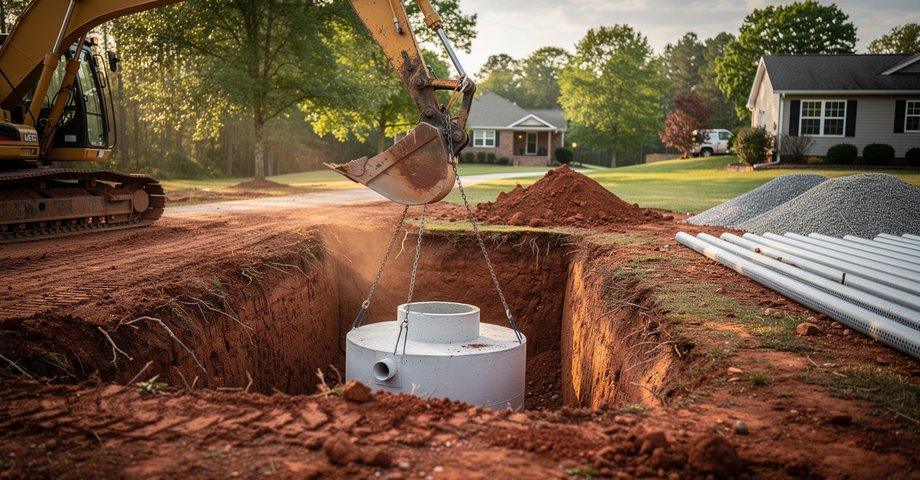
We install septic tanks for new homes and for properties replacing an old system, and we provide ongoing maintenance to keep your system running smoothly after it’s in. Because we’re also a land clearing and grading company, the clearing, digging, and grading around your system are handled by the same crew that installs it. A septic system is an investment you’ll live with for years, so we take every precaution to get it installed correctly the first time.
Why Every Septic Job Starts Underground
The reason you can’t get a firm plan on day one comes down to one test. A soil evaluation, often called a perc test, measures how fast water moves through the ground on your property. That single number drives almost everything that follows. If the soil absorbs water well, you have more options. If it drains slowly, the design has to compensate — usually with a larger drain field or a different system type altogether. The test also helps set where the system can physically go on your lot, since the drain field needs room and the right conditions to work. Until that evaluation happens, any system type, any tank size, any layout is just a guess. That’s not a contractor stalling you. It’s the ground setting the rules before the project can be designed around them.
Permits and Health Department Approval
Septic work in North Carolina runs through your county health department (for most Hickory addresses, that’s Catawba County), and the sequence matters more than most people realize. First comes the soil evaluation. Based on those results, a permit application goes in, and the health department reviews a proposed system design against what your lot can support. Once that design is approved, installation can begin — and when the work is done, there’s a final inspection before the system is cleared for use. Each step depends on the one before it, which is why a project that skips ahead tends to get stuck. The approved permit isn’t a formality, either. It’s the document that defines what system you’re allowed to install and how big it has to be. If you’re building new and trying to line this up with the rest of your construction timeline, understanding that order early saves you from scheduling headaches later. We’re glad to talk through where septic fits in your overall build so the clearing and site work happen at the right moment.
Gravity or Pump: Your Lot Decides
You’ll hear two main system types tossed around, and which one you end up with isn’t really your call — it’s your land’s. A gravity system does exactly what it sounds like. Wastewater flows downhill from the house to the tank, then out to the drain field, with no mechanical help. It works beautifully when your lot has the right slope and the drain field sits lower than the tank. A pump system comes into play when gravity can’t do the job on its own, usually because the drain field is uphill or there isn’t enough natural fall across the property. The pump pushes effluent where it needs to go, which means adding mechanical parts to the system. So the deciding factor is elevation, not preference. Where your drain field has to sit relative to your house tells you which way this goes.
Sizing the Tank for Your Household
A lot of folks worry about guessing wrong here — paying for more tank than they need, or installing something too small for the family. Good news: it isn’t a guess, and it isn’t up to you. Tank and drain field size are tied to the home’s capacity, which in permitting usually tracks with the number of bedrooms rather than how many people currently live there. A three-bedroom house gets sized the way a three-bedroom house gets sized, because the next owner might fill every room. The approved permit sets the requirement, and that takes the pressure off of you to figure it out. If you’re unsure what your situation calls for, the health department’s determination during the design review is what settles it.
Site Prep and Grading for Drain Fields
Getting the ground ready is part of our job too, and it matters more than people expect. Once a drain field location is approved, that footprint has to be cleared and prepared the right way. We open up the approved area, remove the trees, stumps, and brush in the way, and get the ground ready for the system to be set. Grading is a big piece of it. The land around a drain field needs to shed surface water away from the field rather than letting rain pool over it, because standing water and a working drain field don’t mix. We also make sure there’s clean access so equipment can reach the spot without tearing up the rest of your property. On new builds around Hickory, Denver, and Sherrills Ford, getting this phase right keeps the whole project moving and protects the system you’re about to pay for. Done poorly, it causes problems you won’t see until the system starts struggling.
If you’re planning a new septic system, or you’ve got a lot that needs clearing and grading before one goes in, call us at 828-503-5767 and we’ll talk through what your site needs.
Failing Systems: Repair or Replace?
If you already have a septic system, the warning signs tend to show up slowly, then all at once. Slow drains throughout the house, gurgling, a lingering odor outside, or soft wet spots over the drain field are all worth paying attention to. Here’s the honest part: those symptoms don’t tell you whether you’re looking at a simple repair or a failed drain field. Only an inspection sorts that out. Sometimes the fix is minor. Sometimes the field has reached the end of its life and needs to be replaced. Don’t panic and don’t assume the worst — but don’t ignore it either, because a small problem left alone rarely stays small. When a system does need replacing, we can handle the new installation, and our ongoing maintenance helps keep a working system healthy.
What Drives Septic Cost in Hickory
We won’t throw a fake number at you, because an honest price depends on things we have to see first. What makes one septic project cost more than another usually comes down to a handful of factors you’ve already read about here: what your soil evaluation shows, whether your lot needs a gravity or pump system, the size the permit requires, how easy your property is to reach, and how much clearing and grading the site needs before work can start. A flat, open lot with good soil near Denver is a different project than a wooded, sloped parcel out toward Lenoir. Once we understand your specific situation, the picture gets a lot clearer.
The simplest way to find out what your property needs is to talk it through with someone who’s looked at a lot of land around the Hickory area. Give us a call at 828-503-5767 and we’ll help you figure out your next step, whether you’re starting a new build near Mooresville or dealing with a tired system at home in Hickory.
Frequently Asked Questions
How long does the whole septic process take?
Timing depends mostly on the steps outside anyone’s control, like scheduling the soil evaluation and getting health department approval on the design. The clearing, grading, and installation work moves faster than the approval stages in most cases. Once we see your lot and know where you are in the permitting sequence, we can give you a realistic window.
Do I need to be home while work is happening?
For most of the site prep and grading work, you don’t need to be on the property the whole time. We do like to walk the site with you at the start so we’re clear on access, boundaries, and where everything is going. After that, we can keep you updated without you having to stand out in the yard all day.
Can you clear my lot before the soil test is done?
It’s usually best to hold off on clearing the exact drain field area until the soil evaluation and approved design tell us where the system is going. Clearing the wrong spot can cost you time and money. We’re happy to coordinate so the site work lines up with your approval instead of jumping ahead of it.
What should I have ready before calling?
If you have your property address, a rough idea of the home size or bedroom count, and any paperwork from a soil test or permit already in motion, that helps a lot. Even if you have none of that yet, call anyway. We can point you toward the right first step for your situation.
Do you work outside of Hickory?
Yes. Along with Hickory, we handle site work across the surrounding communities, including Denver, Huntersville, Lenoir, Mooresville, and Sherrills Ford. You can see all the areas we serve here. If you’re not sure whether your property is in our range, just ask when you call.