Harley Raking
You hired someone to clear the land, and they did. The trees are gone, the stumps are out, and from the road it looks like a finished job. But stand on it. Walk it. What you’ve actually got is ruts from the tracks, fist-sized rock pushed to the surface, root chunks poking up, and lumpy subsoil that no grass seed is going to take to. That gap between “cleared” and “ready to grow something” is exactly where Harley raking comes in, and it’s the step a lot of folks in Hickory don’t realize they still need until they’re standing on rough ground wondering why it won’t seed.
Cleared Isn’t the Same as Finished
Clearing gets the big stuff off your property. It doesn’t leave you with a surface you can plant, build on, or turn animals out on. That’s a separate job. Harley raking handles the finishing work — rock raking, soil conditioning, and land smoothing — so the dirt underneath actually becomes usable. If your ground looks done but feels rough and rocky under your boots, you’re not imagining it. You’re just one step short.
What a Harley Rake Actually Does
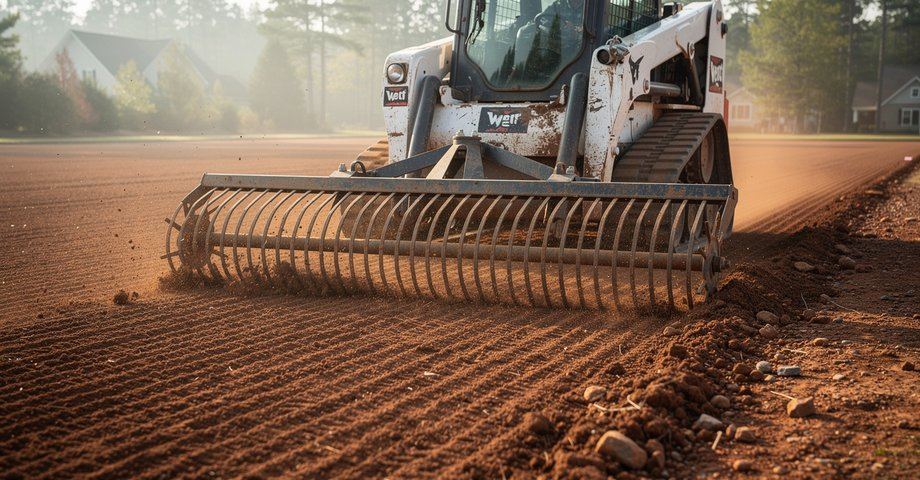
A Harley rake, sometimes called a power box rake, is an attachment that mounts on a tractor or skid steer. It’s got a rotating drum lined with carbide teeth, and that drum does three things in a single pass. First, it chews up and breaks apart compacted soil, loosening the ground that heavy equipment packed down hard. Second, it grabs surface rock, root fragments, and leftover debris and pulls them into windrows — neat rows you can then haul off or gather up. Third, it levels the surface as it goes, knocking down the high spots and filling the low ones.
That combination is what makes it the right tool when the ground is rough but not badly out of grade. You’re not just dragging dirt around. You’re pulverizing soil, separating out the junk, and smoothing the whole thing at once. For a property that’s been cleared but left rocky and torn up, there isn’t a cleaner way to get it right.
From Rough Ground to Seed-Ready
It helps to see where raking fits in the overall sequence. After the land gets cleared, you’re left with that rough surface — rock, roots, ruts, and packed dirt. The next move is debris and rock removal, pulling the leftover material out so it isn’t sitting under your future lawn. Then comes the soil conditioning, where the compacted ground gets broken up and loosened. After that, final grading and land smoothing bring the surface level and even.
What you end up with is topsoil preparation that leaves you a real seedbed — loose, clean, level ground that seed can actually root into. This is how the work generally progresses, and every step builds on the one before it. Skip the conditioning and you’re seeding into concrete-hard dirt. Skip the rock removal and you’re planting around stones. The whole point is to close the gap between cleared and plantable in one organized effort.
Lawns, Pastures, and Food Plots
Harley raking isn’t a one-use tool, and that’s part of why so many property owners around Hickory ask about it. For homeowners, it’s lawn seedbed preparation — getting a new yard ready after a build or a clearing so grass comes in thick instead of patchy. For folks with acreage out toward Lenoir or Denver, it’s pasture preparation, smoothing rough ground into something horses or cattle can graze and you can bush hog without rattling your teeth out.
Hunters use it for food plot preparation, turning a cleared corner of the woods into a clean, workable patch for planting. And after any clearing or construction job — whether you’re in Hickory proper or over near Sherrills Ford — it handles plain property leveling, taking that torn-up, rutted mess and making it even again. It also works well for grading dirt and gravel roads, cutting grades, and putting the finishing touches on residential and commercial lot grading. If your situation fits any of those, raking is probably the answer you’re looking for.
If that sounds like the ground you’re standing on, the simplest next step is a quick phone call. Reach us at 828-503-5767 and tell us what you’re working with.
Raking vs. Full Regrading
Here’s the question that keeps people up at night: am I about to pay for the wrong thing? Nobody wants to over-buy, and nobody wants to pay twice. The honest line between raking and full regrading comes down to elevation and drainage.
If your ground is roughly at the right height and the problem is surface roughness — rock, roots, ruts, and compaction — raking is almost certainly what you need. But if you’ve got standing water, a slope that’s sending runoff the wrong way, or a spot that needs real dirt moved to change its elevation, that’s a regrading job, not a raking job. Raking smooths and conditions what’s already there. Regrading reshapes it. Walk your property after a hard rain. If water pools and sits, you’re probably past raking. If it drains fine but the surface is just rough, raking will likely get you where you want to be.
Get Your Hickory Property Raked Right
When you’re ready, give us a call at 828-503-5767 and we’ll talk it through. A few things to have ready will make the conversation easy: the rough size of the area, the current condition of the ground — freshly cleared, old weedy lot, rocky fill — and what you’re hoping to do with it, whether that’s a lawn, a pasture, or a food plot. That’s enough for us to understand your situation and get you an estimate. We work throughout the Hickory area, including Mooresville, Huntersville, and the other areas we serve.
Frequently Asked Questions
Can a Harley rake pull out rocks and root pieces, or just smooth the dirt?
It does both. The drum’s teeth lift surface rock and root fragments and pull them into windrows while conditioning the soil at the same time. Keep in mind it handles surface debris — buried boulders or large stumps still call for excavation before raking makes sense.
Should I seed before or after Harley raking?
After, every time. The raking is what creates your seedbed, so seeding beforehand would just bury the seed or churn it up. The best move is to seed onto freshly conditioned soil before the next rain re-compacts the surface.
My lot was cleared last year and grew up in weeds. Is it too late to rake?
Not at all. Light vegetation and weeds can usually be worked right into the process. If the regrowth is heavy — thick brush or small saplings coming back — it may need a clearing pass first, but delaying doesn’t ruin your chances.
How do I know if my ground needs raking or something bigger?
Walk the property and look. Standing water, obvious slope problems, or spots that need their elevation changed all point to something bigger than raking. Surface roughness, loose rock, and packed-down compaction point straight to raking.
Will Harley raking fix tire ruts and compaction from the clearing equipment?
Yes. Breaking up compacted soil is one of the main things the tool does, so those ruts and packed tracks from the heavy machinery are exactly what it’s built to work out. The drum loosens the ground and levels the surface in the same pass.
Do you offer financing for this kind of work?
We do offer financing through our third-party partner, Upgrade.com, which can make a larger project easier to manage. Give us a call and we can point you toward the application and talk through what fits your situation.