Drainage Solutions
If there’s a spot in your yard that holds water for days after a storm, you’ve probably already tried to fix it. Maybe you extended a downspout, dug a shallow trench, or dumped in a few bags of topsoil. And then it rained again, and the water came right back to the same place. That’s the thing people miss about drainage problems: water isn’t choosing that spot by accident. The land is sending it there. We help homeowners and businesses around Hickory get water moving where it should go instead of where it keeps collecting.
Standing Water Doesn’t Fix Itself
You know the signs because you’ve been staring at them. Soggy grass that squishes underfoot. A low corner that turns into a shallow pond every time it rains. Washout lines cutting across the yard where water runs the same path over and over. Mulch and gravel that keep ending up somewhere they didn’t start. None of that clears up on its own, and the frustrating part is that it tends to come back worse each season. Water follows the easiest downhill route it can find, and if that route runs toward your house, your driveway, or your crawlspace, it’ll keep running there until something changes the shape of the ground.
Why Drainage Starts With Grading
Here’s why those quick fixes usually fail. A pipe or a drain doesn’t pull water toward itself. Water only moves when gravity tells it to, and gravity listens to slope. If the ground around a drain is flat or tilted the wrong direction, water just sits next to it or walks right past. That’s why we look at drainage and grading as one job, not two. Grading is how we control the direction water travels, how fast it moves, and where it finally collects. Get the shape of the land right first, and every drain you add afterward actually does its job. Skip that step, and you’re installing hardware that water has no reason to flow into. It’s the difference between telling water where to go and hoping it figures it out.
Drainage Systems for Hickory Properties
There’s no single drain that fixes every yard, which is good news. The right setup depends on where the water is coming from and whether the trouble is above ground or soaking in below. Here are the approaches we rely on most often for properties in and around Hickory.
French Drain Installation
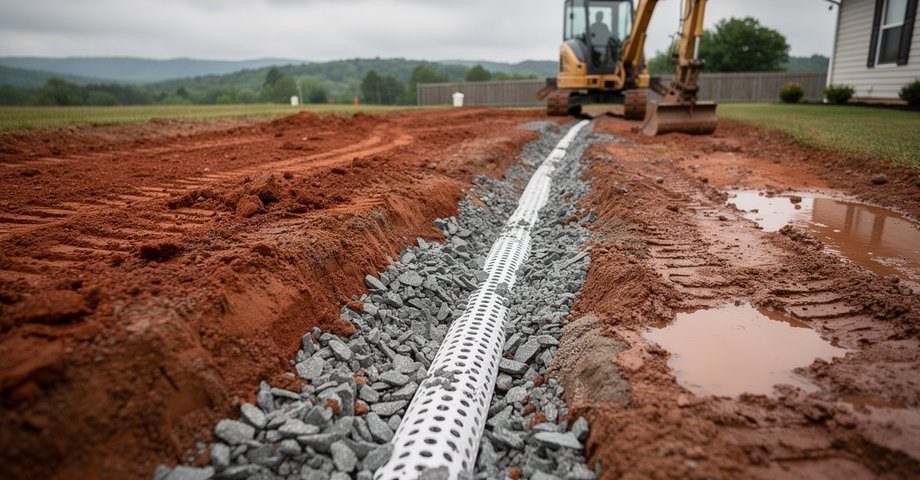
A French drain is simpler than the name makes it sound. It’s a perforated pipe laid in a gravel-filled trench, buried below the surface. Water in the soil seeps down through the gravel, enters the pipe through the holes, and gets carried off to a lower discharge point. What makes it useful is that it handles water you can’t always see, the kind that saturates the ground and keeps an area spongy long after the rain stops. When the problem is underground moisture rather than a visible puddle, collecting that water below the surface usually works better than trying to redirect it from the top. It’s a quiet, buried solution that keeps doing its work out of sight.
Catch Basins and Surface Drains
When water pools on the surface, a catch basin gives it somewhere to go. It’s a boxed inlet set into a low spot, a driveway edge, or the foot of a patio, with a grate on top. Surface water drops into the basin, then feeds into buried pipe that carries it away to a safe outlet. These work well for the obvious puddles, the ones that form in the same dip every single storm. Instead of letting that water sit and soak in, a catch basin grabs it right where it collects and moves it along.
Downspout and Gutter Drainage
Your gutters catch a surprising amount of water, and if the downspouts dump it right at the base of your house, you’ve got a problem feeding itself. We route that roof water into buried pipe that carries it well away from the foundation to a proper discharge point. It’s one of the more straightforward fixes, but it makes a real difference, because you’re stopping gallons of concentrated runoff before it ever reaches the ground next to your walls.
If any of this sounds like what’s happening in your yard, give us a call at 828-503-5767 and we’ll talk through what you’re dealing with.
Regrading, Swales, and Drainage Ditches
Sometimes the issue isn’t one spot, it’s the whole yard tilting the wrong way. That’s when pipe alone won’t cut it and you need to move earth. As a grading contractor, reshaping land is the part of this work we know best. Regrading resets the slope so water drains away from the areas that matter instead of pooling in them. A swale is a shallow, gently sloped channel, usually planted with grass, that guides surface water along a path you choose rather than the one it would carve on its own. For heavier flow, a drainage ditch does the same job on a larger scale. These surface solutions often pair with buried systems, and on larger lots around Hickory, Denver, and Sherrills Ford, that combination is usually what gets a stubborn drainage problem under control for good.
Stopping Erosion Before It Spreads
Erosion is really just drainage failure you can see. When water moves too fast or always takes the same uncontrolled route, it starts carrying soil with it. That’s where the gullies come from, the exposed tree roots, the washed-out gravel, the bare patches where grass used to grow. The fix isn’t to fight the water after it’s already cutting channels. It’s to slow it down, spread it out, and send it somewhere it won’t do damage. Once the drainage is shaped correctly, erosion tends to stop on its own because the force driving it is gone. Erosion control is part of what we handle, and it almost always ties back to getting the water managed first.
What a Drainage Assessment Looks At
When you call us out, we’re not showing up to sell you a drain and leave. A proper look at a drainage problem starts with four questions. Where is the water coming in? Where does it sit? Where can it realistically and legally exit the property? And what’s the slope between those points? The answers decide everything, because the same puddle can call for completely different solutions depending on what’s happening around it. We’d rather understand the whole path water travels than guess at one piece of it. That’s how you end up with a fix that holds instead of one that moves the problem ten feet down the yard. If you’re ready for someone to actually diagnose what’s going on, we’ll come take a look.
Get Water Moving Off Your Property
You don’t have to keep watching the same corner flood every time the sky opens up. Whether you’re in Hickory, Lenoir, Mooresville, or anywhere nearby, we’ll figure out where your water is going wrong and build a plan to redirect it for good. Call Bullet Proof Land Clearing at 828-503-5767 and tell us what you’re seeing. We’ll take it from there.
Frequently Asked Questions
Will installing drainage tear up my whole yard?
Not the whole yard, no. Trenching disturbs the path the pipe runs along, not the entire property, so the amount of digging depends on the system type and how far the water has to travel. A short downspout run is minor, while a longer French drain across a sloped lot involves more. We’ll walk you through exactly what to expect before any work starts.
Where does the water actually go once it’s redirected?
It goes to a lower point where it can safely spread out or daylight to the surface, like a ditch, a dispersal area, or a lower part of your property. We never just push your water problem onto a neighbor’s land. Choosing a smart, responsible discharge point is a big part of designing the system correctly.
Can drainage work be done when the ground is already wet?
Often, yes, and wet conditions can actually help. Standing water during or right after a storm shows us exactly where the problem is and how it moves, which makes diagnosis easier. Whether we can work right away depends on the specific site conditions, so we’ll assess that when we come out.
What affects the cost of a drainage project?
The biggest factors are the size of the area, the type of system needed, and how far the water has to be carried to a good outlet. A single catch basin is a very different job than regrading a whole yard with buried pipe. Once we see the site, we can give you a clear picture of what the work involves.
Do you offer financing?
Yes, we offer financing through our third-party partner, Upgrade.com, so a drainage project doesn’t have to wait. If spreading out the cost makes the timing easier for you, just ask and we’ll point you to the application. It’s a simple way to get the work done when you need it.
Do you handle both homes and businesses?
We do. We work on residential yards and commercial properties alike, and the core approach is the same either way: understand where the water goes, then reshape and redirect it. Commercial sites often involve larger runs and more surface area, but the goal of keeping water off the property doesn’t change.