Forestry Mulching
Picture standing at the edge of a piece of land you own but can’t actually use. Maybe it’s acreage you just bought in Hickory, maybe it’s a lot that’s been swallowed by underbrush over the years. You want it cleared, but you’re worried heavy equipment will scrape everything down to raw dirt and take out the trees you actually like. That’s the fear most folks carry when they start looking into clearing. Forestry mulching is the answer a lot of people are looking for without knowing the name for it. It removes what you don’t want and leaves the good trees, the soil, and the ground cover right where they are.
Forestry Mulching in Hickory, NC
Our whole approach comes down to one idea: “Transforming Landscapes, Unleashing Potential.” Forestry mulching might be the most literal version of that there is. You take land that’s choked out and unusable, and you turn it into something you can walk, build on, or farm. We handle forestry mulching and land clearing for property owners across Hickory and the surrounding area, from residential lots to commercial sites. If you’ve got a piece of ground that’s gotten away from you, this is the service built to bring it back. Want to talk through what you’re dealing with? Call us at 828-503-5767 and we’ll walk you through it.
What Forestry Mulching Actually Is
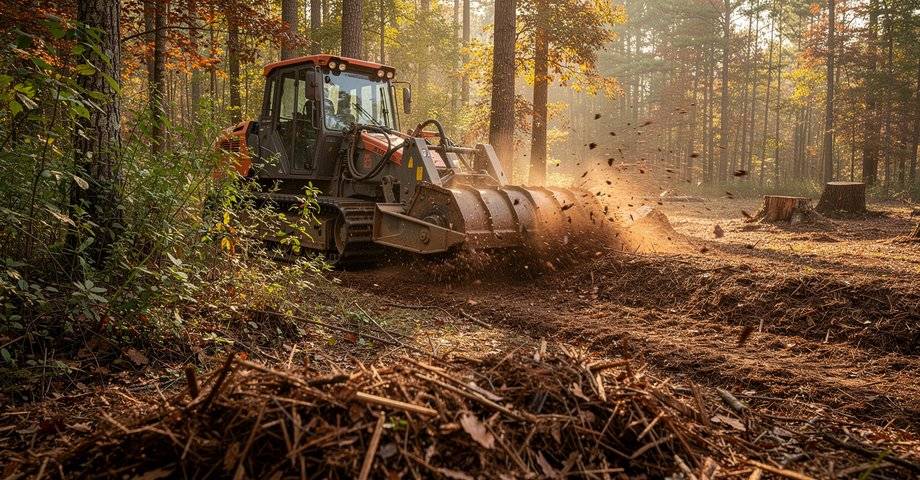
Here’s the short version. A mulching attachment rides on a machine and grinds standing brush, saplings, and underbrush right where they stand. Instead of cutting everything down, hauling it off, and leaving a pile of debris to deal with, the material gets ground into a mulch layer that stays on the ground. One pass, and what used to be a thicket turns into clean, walkable earth with a blanket of wood chips on top.
That’s the big difference between underbrush mulching and old-school clearing. There’s no burn pile, no dump trailer full of brush, no scraped-bare lot. Brush clearing and removal happens in a single motion, and what’s left behind actually looks finished instead of torn up.
When Mulching Beats Traditional Clearing
Mulching isn’t the right tool for every job, and we’ll always tell you that straight. But it shines in a lot of situations. If you want selective clearing, meaning you want the underbrush gone but the mature oaks and hardwoods left standing, mulching is hard to beat. It lets an operator work around the trees you want to keep instead of knocking everything flat. It’s also a strong choice for thick undergrowth that has crowded out everything else.
There’s another perk. That mulch layer left on the ground helps hold soil in place and softens the impact of rain on freshly worked land, which matters when you’re thinking about erosion after clearing. Now, if you’re prepping a lot for a house foundation or a commercial pad, traditional lot clearing sometimes makes more sense because you’ll need bare, graded ground anyway. Not sure which camp your project falls into? That’s a quick phone conversation. We’d rather point you to the right method than sell you the wrong one.
Overgrown Lots, Fence Lines, and Access Paths
Most of what comes our way falls into a few recognizable buckets. Overgrown lot clearing is the classic one, where a property has sat for years and nature took over. Mulching chews through that mess and hands you back usable land. Reopening a fence line you can no longer walk or cutting back an overgrown access path is another common job.
We also handle lot clearing to prep for construction, knocking down the brush so you can see what you’re actually working with before the real build starts. Every one of these jobs looks a little different depending on what’s growing and how thick it is, which is exactly why we like to put eyes on it before quoting anything.
Equipment, Safety, and Your Property
A big worry we hear is whether machinery is going to tear up the land. Fair question. The machine used for this work, a forestry mulcher with hydraulically driven blades, is a good bit gentler on the ground than the excavate-and-haul method. It works from the top down, grinding in place, so you’re not digging up the whole surface and dragging debris across your property. Less traffic, less disturbance, less mess to clean up afterward.
Our service runs on three things working together: efficient, effective, and safe operations. Safety isn’t a line we tack on at the end. Working around trees, slopes, and property lines takes a steady hand and a clear plan, and that’s how we run every job. The goal is to leave your property better than we found it, not beat it up getting there.
If you’re ready to get a real sense of what mulching would look like on your land, call 828-503-5767 and we’ll set up a time to take a look.
What Drives Acreage Clearing Cost
Everybody wants a number, and we get why nobody posts one online. The honest reason is that no two properties price the same. What moves the cost is the acreage, how dense the vegetation is, the terrain and how steep it gets, how easy the site is to reach, and the size of the material you’re clearing. A flat acre of light brush is a completely different animal than rough, wooded acreage packed with mature saplings.
Here’s where mulching earns its keep. Because it’s a single-pass process with no separate haul-off and disposal step, you’re cutting out a whole stage of labor and equipment. We built our work around saving folks time and resources through efficiency, and that one-pass approach is a big part of how that plays out. To get a real figure, though, we need to see what you’ve got. Give us a call and describe the property, or better yet, let us come look.
Get a Mulching Quote in Hickory
Land that’s been sitting useless can become something you actually walk, use, and enjoy again. That’s the whole point of what we do. If you’re in Hickory, Lenoir, Denver, Mooresville, or anywhere nearby and you’re staring at a property you want back, let’s talk about it. Call 828-503-5767 and tell us what you’re working with. We’ll help you figure out whether mulching is the right call and what it’ll take to get your land cleared.
Frequently Asked Questions
Will mulching damage the trees I want to keep?
No, and that’s actually the whole advantage of the method. An operator works around the trees you want left standing, so you can keep your mature hardwoods and shade trees while clearing out everything beneath them. Just mark or point out the keepers during the on-site walkthrough and we’ll plan the work around them.
Do the stumps stay after forestry mulching?
Mulching typically grinds material down to at or near ground level, so you won’t be left with tall stumps, but it’s not the same as full stump removal or grinding. If you need the ground completely stump-free for a specific use, let us know when you call and describe what you’re planning. That way we can talk through the right scope for your project.
Can I build or plant on land right after mulching?
It depends on what you’re doing with it. The mulch layer breaks down over time and works fine for things like pasture or general landscaping, but a building pad needs different ground prep than planting does. Tell us your end goal when you call and we’ll point you toward what that land will need.
Does weather or wet ground delay the work?
It can. Saturated or muddy ground affects both scheduling and how well equipment can get around a site without leaving ruts. If conditions aren’t right, we’d rather wait a few days than tear up your property, and we’ll keep you in the loop on timing.
Do I need to be on the property during the work?
Not necessarily. What matters most is that we have clear access to the site and that the property boundaries are marked so there’s no guesswork. We’ll confirm the details with you during the quote so everyone’s on the same page before the crew shows up.
How should I prepare my land before the crew arrives?
A few simple things help a lot. Mark your property lines, flag the trees you want to keep, and point out any hidden hazards like wells, septic tanks, or buried lines. Make sure any gate or access point is open and reachable, and we’ll handle the rest.